

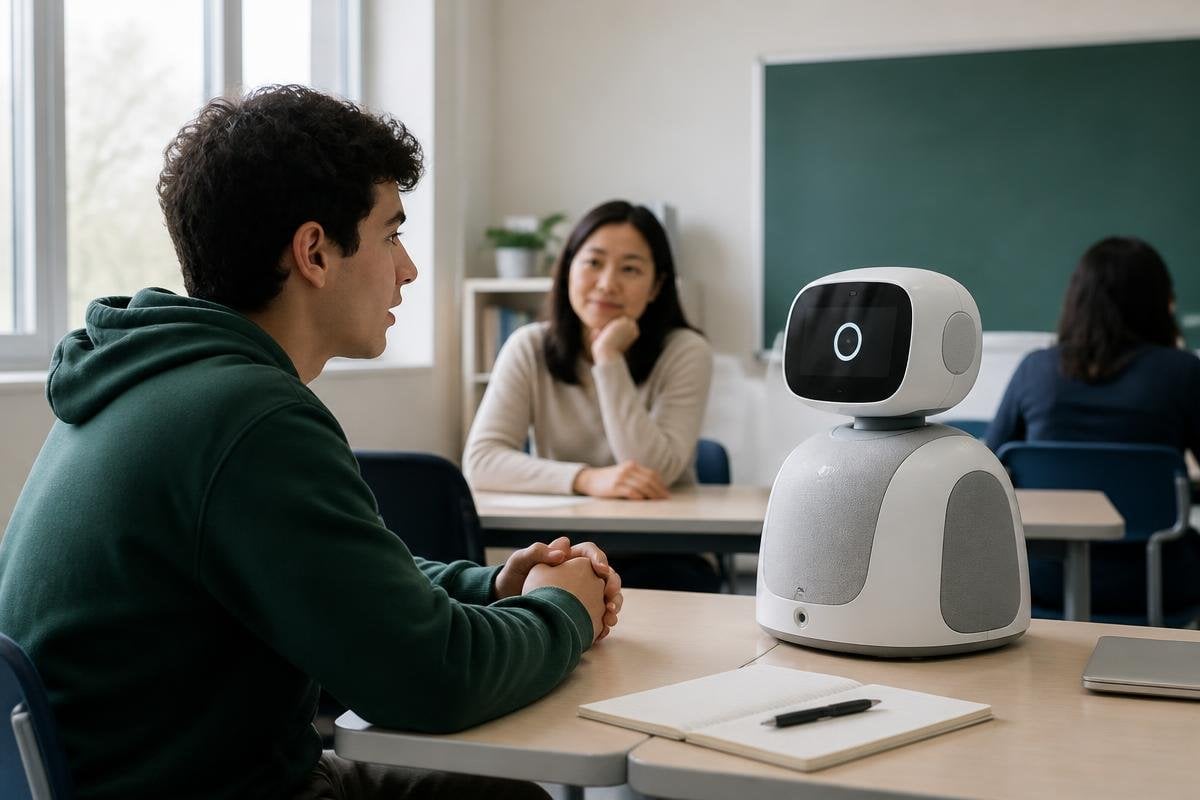
A robot can listen through a microphone, turn speech into text, and answer through a speaker or screen. Those parts make language practice possible, but they don’t make the robot a teacher by themselves.
If you’re considering one for a school, lab, or training room, the useful question is narrower: which practice task can the robot handle well, and where does a person still need to step in?
Quick read
- Robots can give learners repeated speaking practice without using a teacher for every turn.
- Speech recognition may struggle with accents, background noise, and early learner speech.
- A pilot needs a clear task, a human review point, and a way to protect recorded voices.
Where a robot can help
Language learning needs practice between formal lessons. During a practice session, the robot can ask a prepared question, listen for an answer, and reply with speech, text, or a prompt on its display. That gives a learner another turn without requiring a teacher to lead every exchange.
The system can also run a fixed role-play. It might act as a customer, a hotel clerk, or a patient while the learner asks questions in the target language. A fixed script makes the task easier to check because the teacher can see the words, topics, and reply types the system should handle.
Pronunciation practice is another possible use. The system can compare a recorded answer with a target phrase and point to a sound or word for another try. That result needs care: a speech score is a software output, not a final judgment about a learner’s ability.
A language robot needs testing in the places where learners actually speak. Reports on language robots at Robot 24 can put the microphone setup, speech system, and school trial beside the maker’s claim, showing whether it hears a learner in a noisy classroom or only in a quiet demo.
The hard part is listening
Speech recognition turns audio into text, but the robot has to make several decisions after that. It needs to separate the learner’s voice from room noise, detect when the learner has finished, and decide whether an answer matches the task.
A wrong transcript can send the lesson in the wrong direction. If a learner says a word with an accent and the system records another word, the robot may correct the wrong problem or reject a good answer. The teacher needs a way to view the transcript and fix the activity when the system misses.
Turn-taking also matters. A reply that comes too soon cuts off a slow speaker. A long pause can feel like a failure even when the learner is still forming a sentence. The timing settings should be tested with the actual age, level, and room conditions of the class.
What a robot cannot replace
A teacher sees more than the spoken answer. They can notice confusion, change the pace, explain a grammar point in a new way, and decide when a learner needs a harder task. A robot following a preset activity won’t make those choices well in every situation.
Human review also matters for meaning. A learner may use an unusual sentence that still works in context. A system trained to compare answers with a target phrase may mark it as wrong, even though communication succeeded.
Privacy adds another limit. Voice recordings, transcripts, and learner profiles need clear storage rules. A school should know what the robot saves, where the data goes, who can view it, and when it is deleted.
Those answers belong in the purchase decision, not after the first lesson.
I’d use a robot for repeated practice, not for grading a learner’s language on its own.
A small pilot that can answer useful questions
Start with one task and one learner group. A short pilot can test whether the robot hears speech in the room, keeps the exchange on topic, and gives teachers enough control to correct errors.
Use this checklist before buying or expanding the system:
- Pick one task: choose speaking drills, role-play, pronunciation practice, or vocabulary prompts.
- Set a human check: decide which answers a teacher must review before a learner sees a score.
- Test the room: run the same activity with normal noise, distance from the microphone, and several speaking speeds.
- Check the record: list every voice file, transcript, and learner detail the system stores.
- Measure the lesson: record completed turns, teacher correction time, and system errors rather than relying on novelty.
Those checks connect the robot’s parts to the work a language class needs. A microphone and speech model matter only when they reduce a real teaching burden without adding more correction work.
The next useful proof is a classroom result: can learners complete more spoken practice while teachers spend less time fixing wrong transcripts and scores?
